Ever wondered what’s right under your feet?
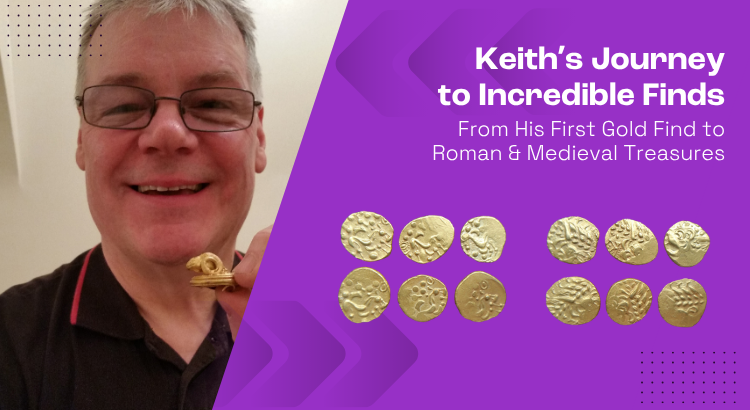
For Keith, that question became the start of an incredible metal detecting journey. Living in Dorset, Keith took up the hobby after retiring in 2016, never expecting that within just a few weeks he would be holding a beautiful gold artefact in his hands, followed shortly afterwards by six exceptionally rare Iron Age gold coins.
Keith admits that he didn’t follow the usual advice when choosing his first detector. Rather than buying an inexpensive machine to see whether he would take to the hobby, he had a feeling that detecting was exactly the sort of pastime he had been looking for, so he decided to invest in a high end detector from the outset.
During his research, the Regton name kept coming up, particularly for the team’s knowledge, helpful advice and first class customer service. Keith already had a detector in mind, but wanted to speak to people who could answer his questions and talk him through his options, so he made the journey from Dorset to Regton in Birmingham.
After chatting with Nigel, Marcus and the team, Keith ultimately left with the detector he had originally been considering: the XP Deus I. Its lightweight design, wireless connectivity, excellent reputation and comfortable feel in the hand were exactly what he was looking for.
It didn’t take long for that decision to pay off.
A first permission and a find of a lifetime

Within a few weeks of buying his Deus I, Keith headed out onto his very first permission. After five hours searching a frozen field full of stone, flint and scrap metal, he hadn’t found anything particularly historic and could easily have called it a day.
Then he got a diggable signal.
What came out of the ground was the sort of discovery most detectorists can only dream about: a beautiful gold Ram’s Head brooch.
For someone who was still a complete newcomer to the hobby, the find was almost surreal. Keith remembers thinking that this was “the stuff of dreams”, having gone out on his first permission and uncovered such a remarkable gold artefact.
The discovery was subsequently declared Treasure and, after going through the lengthy Treasure process, the Ram’s Head brooch was eventually returned to Keith.


Remarkably, however, it wasn’t the only extraordinary discovery his Deus I would make.
Six gold staters, just six weeks later
Around six weeks after finding the Ram’s Head brooch, Keith was out detecting in another part of Dorset when his Deus I produced another exceptional result: a scattered hoard of six very rare Iron Age gold staters.

The significance of the discovery was considerable, with the coins being classified by renowned numismatist John Sills as “probably the earliest British Gold Coinage”. The coins were declared Treasure and went through the Treasure process, eventually being acquired by Dorset Museum in Dorchester.

To make two discoveries of a lifetime within only a couple of months of starting metal detecting was an extraordinary introduction to the hobby, and Keith was well and truly hooked.
Since those early days, he has continued detecting and has added an XP Deus II to his collection. It has gone on to produce a fascinating range of Roman, medieval and other historic finds, often in challenging conditions and alongside his detecting partner, Gillian.
Discovering history with the Deus II
Keith’s approach to detecting is clearly about more than simply turning on a machine and following a target ID. He has tried and tested programmes and settings that build up his own suit his own detecting style, including the Sensitive Full Tones programme on his Deus II. XP describes Sensitive Full Tones as particularly suited to polluted and mineralised ground, with each target index producing a different tone according to conductivity.
That understanding of his machine has helped Keith recover some fascinating targets, including one particularly unusual discovery made in May 2026.
Keith and Gillian were searching a field where they had both previously found Roman and medieval coins and artefacts. The field was in stubble and the ground was hard and dry, and although they hadn’t found much that day, Keith received a signal that was worth investigating.
Using his usual Sensitive Full Tones programme with the X/Y display and the Iron Volume set to 3, the target ID moved between 63 and 80 depending on the angle of the sweep, while the X/Y trace was also wavering. The target wasn’t giving a straightforward response, but Keith decided it was worth digging.
When he first unearthed the object, he thought it might be some kind of small vessel stopper. The more he examined it, however, the more he began to suspect that it could be a pin head. The shape of the bird gave it a distinctly ancient appearance, and research, including checking the Portable Antiquities Scheme database, confirmed that he had discovered a Late Iron Age to Roman zoomorphic pin head in the form of a bird.


It was another exciting Iron Age/Roman bronze discovery for Keith, who had already recovered a beautiful and substantial Roman bronze figurine from Dorset.
A Roman denarius from a difficult field
Another memorable Deus II discovery came during an outing with Gillian to a remote area of one of their permissions. Situated on high ground, the location required a steep climb on a blisteringly hot day, and once they reached the field they found long grass and ground that was rock hard and packed with stones and flint.
Despite the conditions, they decided to give it a go. Keith was using the Deus II on Sensitive Full Tones, while Gillian had her Deus I running on the HOT programme. After around half an hour without anything noteworthy, Keith’s Deus II suddenly produced a decent signal around 80.
The ground was so difficult that his spade couldn’t get through it, so Keith had to recover the target using his hand trowel. Around three inches down he finally uncovered a silver coin which he immediately recognised as a Roman denarius, although it wasn’t a type he had seen before.

The coin featured a bust of Venus facing right on the obverse, with L. SVLLA underneath, while the reverse showed a small figure of Cupid holding a palm. Further research revealed that it was actually an early Republican denarius of Lucius Cornelius Sulla, dating to 84–83 BC.

Another ancient coin had been recovered from the ground, and once again the difficult conditions had proved well worth battling through.
A beautifully decorated medieval strap end
Keith’s Deus II has also produced some impressive medieval finds. On another outing in one of his Dorset fields, the ground was extremely parched, although surprisingly easy to dig. A strong signal between 78 and 80 led Keith to another beautifully preserved object.
Once he removed the soil and saw the detail, he realised he had found an ornate medieval strap end, featuring a floral design on the terminal and incised decoration on the box chape where the strap would have been inserted and secured with iron rivets.

Some of the decoration initially appeared reminiscent of Anglo Saxon styles, but further research revealed that the object was medieval and dates from approximately 1350 to 1450.

A detecting partnership
Many of Keith’s more recent adventures have been shared with Gillian, who was herself new to metal detecting when they first began detecting together. Keith gave her advice, she watched his YouTube videos and saw the finds in his cabinet, and eventually decided to take up the hobby herself.
Gillian also chose a Deus I and has gone on to make some fantastic discoveries of her own, including a stunning medieval Philip “The Bold” gold noble dating from 1384–1404.


The pair now regularly head out detecting together and share their adventures and discoveries through their YouTube channel, giving other detectorists an opportunity to follow their outings and see what they uncover.
The story continues
Looking back at Keith’s detecting journey, it’s remarkable to think that it all began with a decision to try something new after retirement and a drive from Dorset to Regton in Birmingham to choose his first detector.
Within weeks, his Deus I had led him to a gold Ram’s Head brooch. Six weeks later came six rare Iron Age gold staters, followed over the years by Roman coins, Iron Age and Roman bronze artefacts and medieval treasures.
Yet perhaps that’s the most appealing thing about Keith’s story. Despite having already made discoveries that many detectorists would consider the finds of a lifetime, he is still out there searching, often in difficult conditions and never knowing what the next signal might reveal.
Because that’s the fascination of metal detecting. You can spend hours searching a field without finding anything particularly exciting, only for one uncertain signal to lead you to an object that has been hidden beneath the soil for hundreds or even thousands of years.
You can follow along with Keith and Gillian’s metal detecting journey on their YouTube channel, Hopeus Maximus – Metal Detecting Coins & Artefacts, where they regularly share their detecting adventures, finds and experiences in the field.
If Keith’s story has inspired you to take up metal detecting as a new hobby and you’d like some advice on choosing your first detector, our team at Regton is always happy to help. You can get in touch with us on 0121 359 2379, through our contact form, or come and visit us in store and speak to the team in person.